
OSHA Pallet Rack
Requirements
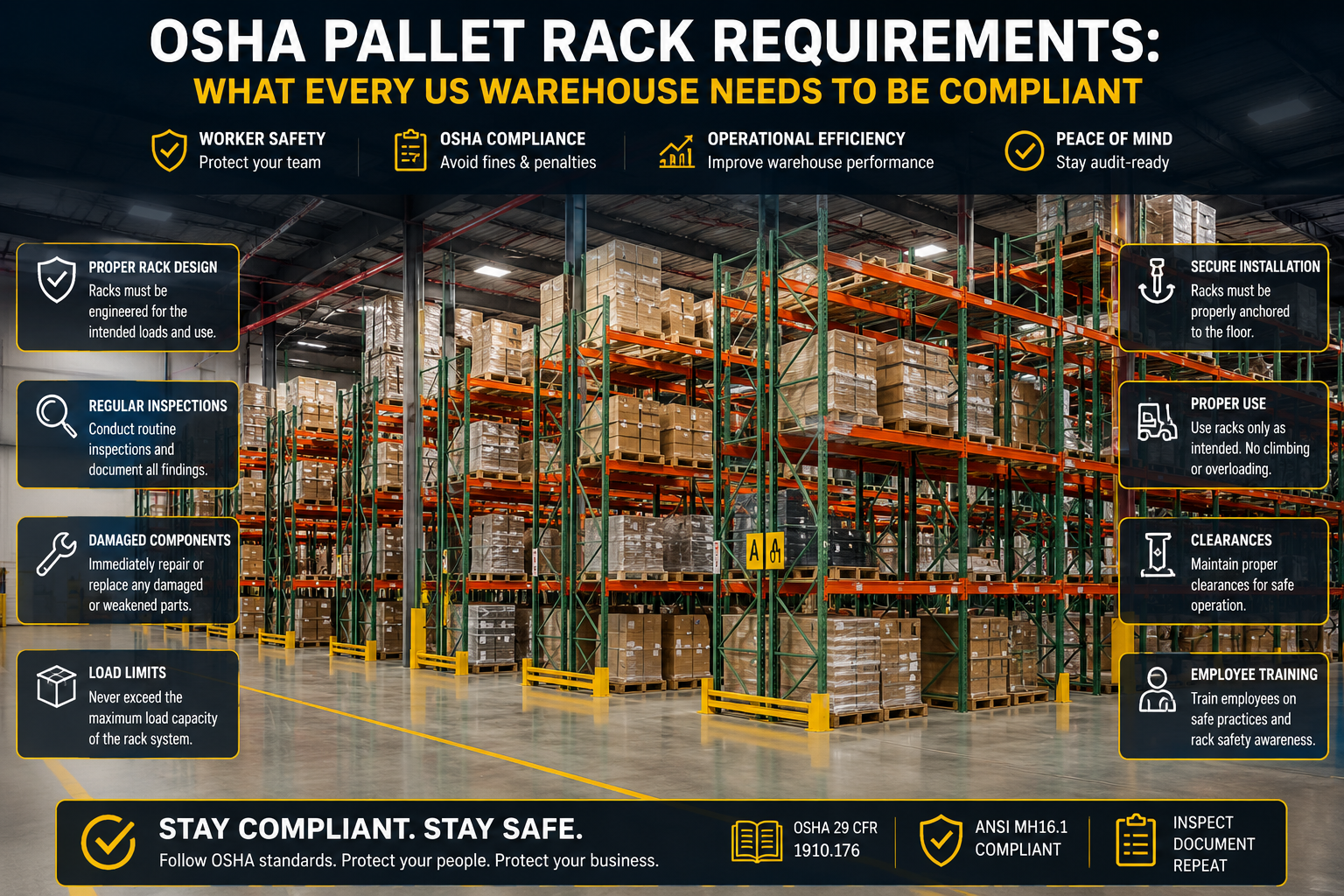
No single OSHA standard covers pallet racking — compliance comes from overlapping federal regulations, ANSI MH16.1, and RMI guidelines. This guide explains exactly what your warehouse must do to stay compliant, pass inspections, and avoid costly fines.
The Regulatory Framework:
OSHA, ANSI & RMI Explained
Understanding which rules apply to your warehouse requires knowing where pallet rack compliance actually comes from. It's not one document — it's a layered framework built from overlapping federal regulations and voluntary engineering standards that OSHA inspectors treat as effectively mandatory.
An OSHA inspector walking into your warehouse isn't looking for reasons to write citations. But if your pallet racking has visible damage, missing load placards, overloaded bays, or blocked aisles, they don't have to look hard. Racking-related violations are among the most frequently cited warehouse hazards in the US — and the fines are not small.
OSHA 29 CFR 1910.176:
The Core Racking Regulations
Three specific provisions within the Materials Handling and Storage regulation directly impact pallet rack compliance in US warehouses. Understanding each one is the foundation of your compliance program.
ANSI MH16.1: The Engineering
Standard OSHA References
ANSI MH16.1 — officially titled "Specification for the Design, Testing and Utilization of Industrial Steel Storage Racks" — is the industry's engineering bible for pallet racking. Published by the Rack Manufacturers Institute, it defines how racks must be designed, tested, and installed to perform safely.
While technically a voluntary standard, OSHA inspectors regularly cite it as the basis for determining whether a racking system was installed and maintained in a safe manner. Several states have also incorporated it into mandatory building codes. Most US warehouse operators should treat it as effectively mandatory.
Load Placards: Your Most
Important Compliance Document
If there's one single compliance item that OSHA inspectors zero in on during warehouse racking inspections, it's the load placard. Under both OSHA 1910.176(b) and ANSI MH16.1, every individual rack bay should display a placard covering all five required elements.
Common Violations &
OSHA Fine Structure (2025)
OSHA penalty amounts are adjusted annually for inflation. Here are current fine levels and the racking-related situations that typically trigger each category.
Pallet Rack Inspection
Requirements: How Often & By Whom
OSHA does not mandate a specific inspection schedule for racking, but it requires storage areas be kept in safe condition. ANSI MH16.1 and RMI guidelines fill in the detail — and OSHA inspectors expect to see evidence of a regular inspection program.
Aisle Width Requirements
by Equipment Type
OSHA 1910.22(b) requires permanent aisles be appropriately marked and clear — but doesn't specify exact widths. Minimums are determined by the equipment being used and applicable building codes. Here's the practical guide for US warehouses.
Seismic Requirements:
Earthquake Zone Warehouses
If your warehouse is in a seismic zone with a design category of C or higher under the International Building Code, your rack system has additional compliance requirements beyond standard OSHA rules. ANSI MH16.1 includes seismic design provisions that require racks in earthquake-prone areas to be engineered for lateral loads in addition to vertical loads.
Building a Rack Safety
Program That Holds Up to OSHA Scrutiny
A documented rack safety program is the difference between a warehouse that handles an OSHA inspection confidently and one that scrambles to explain gaps. Your program doesn't need to be complex — but it must be consistent and recorded.
When to Call a Professional:
Signs That Require Expert Attention
Some rack compliance situations require more than an internal safety walkthrough. If any of the following apply to your warehouse, contact a certified racking specialist or structural engineer before your next load goes up.