Pallet Storage Solutions

OSHA Pallet Rack Requirements: US Warehouse Compliance Guide | Pallet Storage Solutions
⚖️ OSHA 29 CFR 1910.176
📋 ANSI MH16.1 Standard
🏭 RMI Guidelines
2025 Penalty Amounts
Warehouse Compliance Series

OSHA Pallet Rack
Requirements

No single OSHA standard covers pallet racking — compliance comes from overlapping federal regulations, ANSI MH16.1, and RMI guidelines. This guide explains exactly what your warehouse must do to stay compliant, pass inspections, and avoid costly fines.
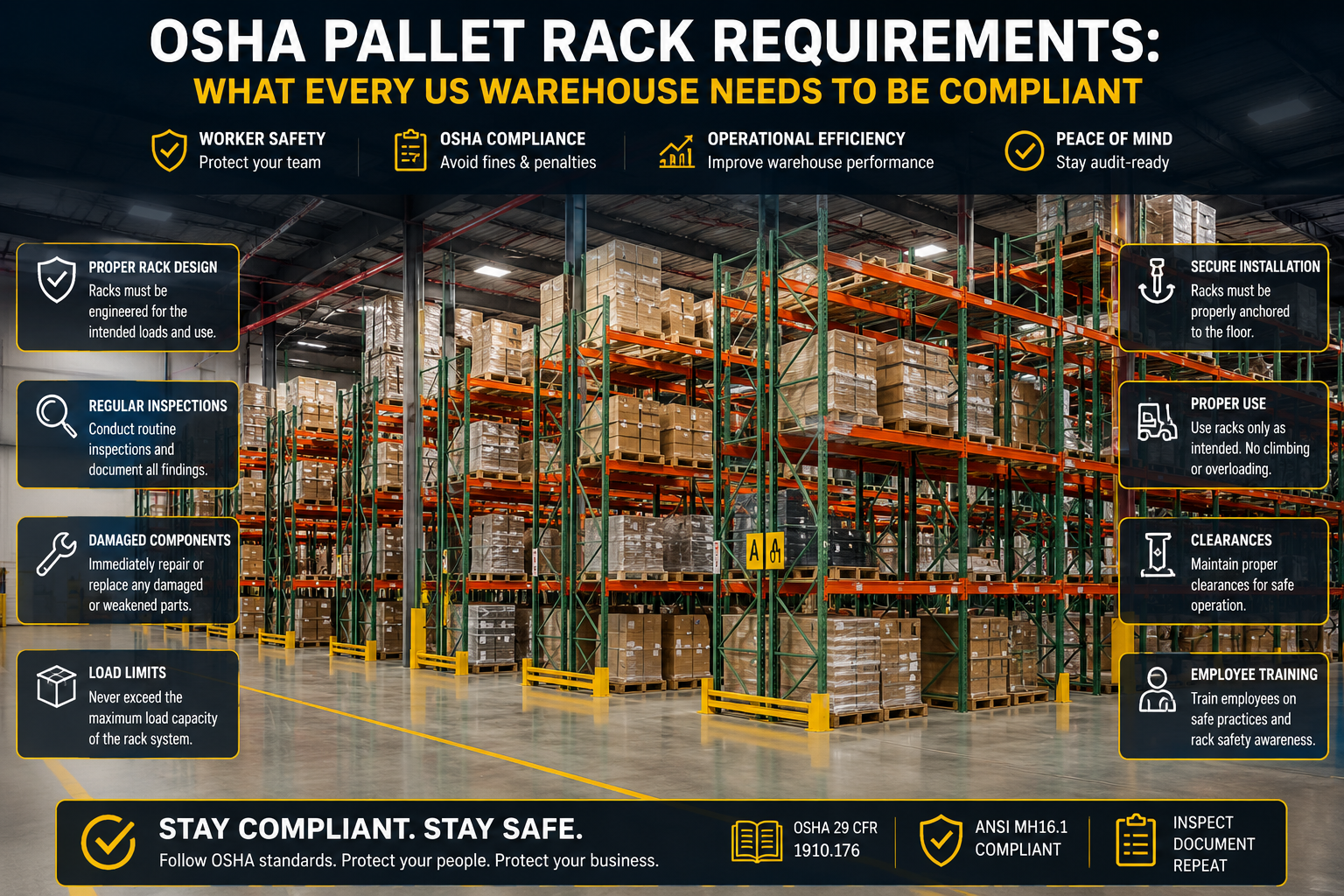
⚖️
OSHA 29 CFR 1910.176
Primary enforcement authority
Enforced
📋
OSHA 29 CFR 1910.22
Aisle clearance & surfaces
Enforced
🏗
ANSI MH16.1
Engineering design standard
Referenced
🔧
RMI Guidelines
Inspection & placard specs
Referenced
🏢
IBC / Local Codes
Seismic & permits
Local AHJ
OSHA Compliance — Pallet Rack Requirements
Section 01

The Regulatory Framework:
OSHA, ANSI & RMI Explained

Understanding which rules apply to your warehouse requires knowing where pallet rack compliance actually comes from. It's not one document — it's a layered framework built from overlapping federal regulations and voluntary engineering standards that OSHA inspectors treat as effectively mandatory.

An OSHA inspector walking into your warehouse isn't looking for reasons to write citations. But if your pallet racking has visible damage, missing load placards, overloaded bays, or blocked aisles, they don't have to look hard. Racking-related violations are among the most frequently cited warehouse hazards in the US — and the fines are not small.

⚡ Key Takeaway
OSHA provides the enforcement authority. ANSI MH16.1 and RMI guidelines provide the technical specifications. Inspectors use both when evaluating a warehouse racking system. Treating only OSHA language as your compliance baseline is not sufficient.
01
OSHA 29 CFR 1910.176
Enforced
General materials handling, safe load limits, aisle clearance, storage condition — the primary standard that directly governs pallet racking in general industry workplaces.
Enforced by: US Department of Labor / OSHA Inspectors
02
OSHA 29 CFR 1910.22
Enforced
Walking-working surfaces, floor conditions, and housekeeping around rack systems. Covers aisle marking requirements and clearance around rack installations.
Enforced by: US Department of Labor / OSHA Inspectors
03
ANSI MH16.1
Voluntary
Engineering design standard for industrial steel storage racks — load ratings, upright specifications, anchor requirements, and beam safety lock protocols.
Referenced in: OSHA citations; adopted into law in several states
04
RMI Guidelines
Voluntary
Rack design, installation guidelines, inspection protocols, and load placard specifications. Published by the Rack Manufacturers Institute and referenced during OSHA enforcement.
Referenced in: Industry self-regulation; OSHA enforcement
05
IBC / Local Building Codes
Local AHJ
Seismic anchoring requirements, structural permits, occupancy loads, and local fire code compliance. Mandatory in all jurisdictions — requirements vary by location.
Enforced by: Local Authority Having Jurisdiction (AHJ)
Section 02

OSHA 29 CFR 1910.176:
The Core Racking Regulations

Three specific provisions within the Materials Handling and Storage regulation directly impact pallet rack compliance in US warehouses. Understanding each one is the foundation of your compliance program.

1910.176(b)
Maximum Safe Loads
The most frequently cited provision for racking violations. Storage areas must have safe load limits clearly marked and those limits must not be exceeded under any circumstances.
In practice: Every rack bay needs a visible load placard showing maximum beam capacity and upright frame capacity. Missing, illegible, or outdated placards are a direct violation of this subsection.
1910.176(c)
Housekeeping
Storage areas must be kept clean and orderly, and floors must be maintained in good condition. This regulation directly impacts how rack base areas, aisles, and surrounding zones are managed.
In practice: Debris around rack bases, damaged materials in aisles, and spillage creating slip hazards near racking are all citable violations under this provision.
1910.22(b)
Aisle Clearance
Permanent aisles and passageways must be appropriately marked and kept clear of obstructions. A separate standard, but enforced in every warehouse rack inspection.
In practice: Forklift aisles between rack rows must maintain minimum clearance for safe equipment operation and cannot be used for overflow storage — ever.
Section 03

ANSI MH16.1: The Engineering
Standard OSHA References

ANSI MH16.1 — officially titled "Specification for the Design, Testing and Utilization of Industrial Steel Storage Racks" — is the industry's engineering bible for pallet racking. Published by the Rack Manufacturers Institute, it defines how racks must be designed, tested, and installed to perform safely.


While technically a voluntary standard, OSHA inspectors regularly cite it as the basis for determining whether a racking system was installed and maintained in a safe manner. Several states have also incorporated it into mandatory building codes. Most US warehouse operators should treat it as effectively mandatory.

💡 Practical Guidance
Treat ANSI MH16.1 as your operational compliance standard — not OSHA language alone. Inspectors use it as the technical benchmark when evaluating whether your racking system was installed and maintained safely. If your system doesn't meet MH16.1, you're likely out of compliance.
📋
Load Placards
Every rack bay must display a placard showing beam capacity, upright frame capacity, beam level spacing, and design date.
Anchor Bolts
Uprights must be anchored to the floor with bolts meeting the diameter, embedment depth, and spacing specified in the manufacturer's engineering drawings.
🏗
Column Base Plates
Base plates must be sized and anchored per the engineering specification — not simply placed on the floor without proper anchor bolts.
🔗
Row Spacers & Bracing
Back-to-back rows of racks must be connected with row spacers at minimum intervals specified in the design drawings.
🔒
Beam Safety Locks
All beam-to-upright connections must have functioning safety locks or pins to prevent accidental beam dislodgement under load.
🚫
Damage Protocol
Any damaged rack component must be immediately removed from service. Racks must not be repaired with field-fabricated parts — only manufacturer-approved components.
Section 04

Load Placards: Your Most
Important Compliance Document

⚠️
Rack Load Placard
Required Display — ANSI MH16.1
Max Beam Pair Capacity5,000 LBS
Max Upright Frame Capacity24,000 LBS
Beam Level Spacing (As Designed)48 IN
System Design / Last Review Date03/2025
Manufacturer / System SeriesPSS-ST
🚨
Missing placards are cited as OSHA violations in their own right — and they remove the only reference workers have for safe loading limits. Without a posted capacity, overloading risk increases dramatically.

If there's one single compliance item that OSHA inspectors zero in on during warehouse racking inspections, it's the load placard. Under both OSHA 1910.176(b) and ANSI MH16.1, every individual rack bay should display a placard covering all five required elements.

Placard Element
Why It's Required
Max beam pair capacity (lbs)
Prevents overloading individual levels; core ANSI MH16.1 requirement
Max upright frame capacity (lbs)
Limits cumulative load across all beam levels per frame section
Beam level spacing as designed
Changing beam spacing without re-engineering voids the original rating
Date of design or last review
Documents when engineering was last verified and by whom
Manufacturer / system series
Ensures only compatible replacement components are used in repairs
If Your Placards Are Missing
If your racks are missing placards — especially used racks purchased without documentation — contact a professional racking company to conduct a load assessment and issue compliant placards before placing any loads on the system.
Section 05

Common Violations &
OSHA Fine Structure (2025)

OSHA penalty amounts are adjusted annually for inflation. Here are current fine levels and the racking-related situations that typically trigger each category.

Category 1
Other-Than-Serious
$16,131
per violation
Common Triggers
Missing load placards
Minor aisle obstructions
Housekeeping violations near rack bases
Category 2
Serious Violation
$16,131
per violation
Common Triggers
Overloaded rack systems
Damaged uprights still in use
Missing beam safety pins
Category 3
Willful / Repeat
$161K
per violation
Common Triggers
Ignored prior citations
No corrective action taken
Repeated hazard after inspection
Category 4
Failure to Abate
$16,131
per day past deadline
Common Triggers
Not fixing cited hazards on time
Incomplete corrective documentation
Hazard still present at re-inspection
Beyond direct fines: A serious rack collapse resulting in worker injury opens the door to willful violation citations, OSHA referral to the Department of Justice for criminal prosecution in egregious cases, and significant civil liability. The cost of a compliant rack inspection program is a fraction of any of these outcomes.
Section 06

Pallet Rack Inspection
Requirements: How Often & By Whom

OSHA does not mandate a specific inspection schedule for racking, but it requires storage areas be kept in safe condition. ANSI MH16.1 and RMI guidelines fill in the detail — and OSHA inspectors expect to see evidence of a regular inspection program.

👁
Every Shift
Operator Visual Check
Forklift Operators
Obvious damage, displaced racks, leaning uprights — anything visually wrong before operations begin.
🚶
Weekly
Supervisor Walkthrough
Warehouse Supervisor
Aisle obstructions, beam deflection, missing safety pins, load placard condition and legibility.
📋
Monthly
Formal Safety Inspection
Safety Officer
Structured checklist covering all uprights, beams, anchors, placards, and aisle markings — with written documentation.
🔬
Annually
Professional Inspection
Certified Specialist
Full structural assessment with a written report — the minimum standard for OSHA compliance documentation purposes.
💥
Immediately
Post-Impact Inspection
Certified Specialist
Required after any forklift strike before the rack section returns to service. Engineering sign-off mandatory.
Inspection records matter as much as the inspections themselves. Document every walkthrough with a dated log, the name of the inspector, and any deficiencies found. If OSHA asks, you need written evidence — verbal assurances don't hold up in a citation hearing. Maintain records for at least three years.
Section 07

Aisle Width Requirements
by Equipment Type

OSHA 1910.22(b) requires permanent aisles be appropriately marked and clear — but doesn't specify exact widths. Minimums are determined by the equipment being used and applicable building codes. Here's the practical guide for US warehouses.

🏗
Counterbalance Forklift
11–13 ft
Clear aisle width required
For standard 48-inch pallets. Most common warehouse configuration — requires widest aisle clearance of all forklift types.
🔧
Reach Truck
8–10 ft
Narrow aisle configuration
Operates effectively in narrow aisle configurations. Common in high-density warehouse environments with selective racking systems.
Very Narrow Aisle (VNA)
5–6 ft
Wire or rail-guided systems
Requires wire-guided or rail-guided equipment systems. Maximizes storage density but requires specialized machinery and floor infrastructure.
🚶
Pedestrian Aisle
28–36 in
Min 36" if emergency egress
28 inches is the absolute minimum. Any aisle used as an emergency exit route requires a minimum 36-inch clearance at all times.
🖊
Aisles must be marked with floor markings or painted lines that clearly delineate rack areas from travel areas. This is an OSHA requirement that inspectors verify visually in every warehouse walkthrough — missing floor markings are a citable violation.
Section 08

Seismic Requirements:
Earthquake Zone Warehouses

If your warehouse is in a seismic zone with a design category of C or higher under the International Building Code, your rack system has additional compliance requirements beyond standard OSHA rules. ANSI MH16.1 includes seismic design provisions that require racks in earthquake-prone areas to be engineered for lateral loads in addition to vertical loads.

01
Enhanced Anchor Bolt Specs
Heavier anchor bolt specifications and deeper embedment in the concrete floor — standard anchor requirements are not sufficient in seismic zones.
02
Additional Cross-Bracing
Additional cross-bracing or down-aisle bracing on rack frames to resist lateral earthquake forces. Must be specified in the seismic engineering drawings.
03
Licensed Structural Engineer Review
Engineering review by a licensed structural engineer registered in the applicable state — not just a manufacturer's standard spec sheet.
04
Local Building Permit Required
Local building permit and inspection before the racking system is put into service. Non-permitted installations in seismic zones are a serious compliance gap.
⚠ High-Risk Seismic Zones
High Risk
California, Pacific Northwest, Alaska — Seismic Zone D+
Moderate Risk
Pacific Northwest inland, parts of Utah, Nevada — Zone C
Watch Zone
New Madrid fault zone (Missouri, Arkansas, Tennessee, Illinois)
Seismic compliance is an area where many warehouse operators unknowingly fall short — particularly businesses that purchase standard rack systems online without consulting a local engineering specialist. Verify your rack system has a site-specific seismic analysis before loading it.
Section 09

Building a Rack Safety
Program That Holds Up to OSHA Scrutiny

A documented rack safety program is the difference between a warehouse that handles an OSHA inspection confidently and one that scrambles to explain gaps. Your program doesn't need to be complex — but it must be consistent and recorded.

Step 01
Post & Maintain Load Placards
Post and maintain load placards on every rack bay. Verify they're visible, accurate, and match your current beam configuration — not the original install if changes have been made.
1
2
Step 02
Written Inspection Schedule
Establish a written inspection schedule with assigned responsibility. Document every inspection with date, inspector name, and findings — verbal walkthroughs don't count.
Step 03
Damaged Rack Protocol
Define what constitutes reportable damage, who makes the call to remove racks from service, and how repairs are authorized. Never use damaged racks while waiting for repairs.
3
4
Step 04
Operator Training on Load Limits
All forklift operators must know the rated capacity of every rack row they work in and know how to report impacts immediately — before the end of shift, not days later.
Step 05
Verify Anchor Bolt Installation
Pull your original installation drawings and confirm base plates are anchored per specification — especially critical if you've inherited a used rack system without documentation.
5
6
Step 06
Annual Professional Inspection
An outside racking specialist brings objectivity and technical expertise that internal teams often can't match for structural assessment. Schedule it — don't wait for an incident.
Step 07
Maintain Records — 3 Years Minimum
OSHA may request documentation from past inspection cycles during any investigation following a warehouse incident. Three years of dated, signed records is the minimum defensible standard.
7
Section 10

When to Call a Professional:
Signs That Require Expert Attention

Some rack compliance situations require more than an internal safety walkthrough. If any of the following apply to your warehouse, contact a certified racking specialist or structural engineer before your next load goes up.

💥
Forklift Strike — Any UprightAny upright struck by a forklift — even a minor impact — must be professionally assessed before returning to service.
📄
Used Racks Without DocumentationPurchased used racks without original load documentation? Load certification is required before any product goes on them.
📐
Adding Beam LevelsAdding beam levels or changing beam spacing on an existing system voids the original engineering rating — re-certification required.
⚖️
Inventory Weight IncreaseYour inventory has significantly increased in weight since the racks were installed. Original load ratings may no longer apply.
🌍
Seismic Zone — First InstallationInstalling racking in a seismic zone for the first time without a site-specific seismic analysis is a compliance and structural risk.
🚫
No Permits — Unsure of CodeRacks installed without permits and you're unsure they meet current code? A professional assessment before your next OSHA visit is essential.
⚖️
Received an OSHA CitationFollowing an OSHA citation related to racking, corrective documentation from a certified specialist is required before abatement is confirmed.
🔍
No Inspection in 12+ MonthsIf your racks haven't had a professional inspection in the past year, you're outside the minimum compliance expectation regardless of visible condition.
Professional Rack Inspection
Don't Wait for an Incident
Professional rack inspection and load certification is not an expensive service relative to the cost of a citation, a rack collapse, or a worker injury claim. It's an investment that pays for itself the first time an OSHA inspector walks through your door.
$16K+
Per serious OSHA violation — per citation
$161K
Per willful or repeat violation
Book a Rack Inspection →
Section 11

Frequently Asked
Questions

Ask a Specialist →
OSHA does not have a single dedicated pallet racking standard. Instead, racking compliance falls under 29 CFR 1910.176 (materials handling) and 1910.22 (walking-working surfaces). OSHA inspectors also reference the ANSI MH16.1 standard and RMI guidelines when evaluating rack safety violations.
OSHA 29 CFR 1910.176(b) requires that safe load limits be clearly marked and not exceeded. In practice, this means every rack bay should display a visible load placard showing beam capacity and upright frame capacity. Missing placards are one of the most common warehouse OSHA citations in the US.
OSHA does not specify an exact inspection frequency, but industry standards under ANSI MH16.1 and RMI guidance recommend daily visual checks by operators, monthly formal inspections by supervisors, and at minimum an annual professional inspection. Any rack struck by a forklift must be professionally inspected before returning to use.
Yes. ANSI MH16.1 requires that rack uprights be anchored to the floor using base plates and anchor bolts sized and installed per the manufacturer's engineering specifications. Unanchored racks are a serious OSHA safety hazard and a leading cause of rack tip-over incidents in US warehouses.
ANSI MH16.1 is the primary American national standard for the design, testing, and use of industrial steel storage racks, published by the Rack Manufacturers Institute. While technically a voluntary standard, OSHA inspectors regularly reference it when citing racking hazards. Most US warehouse operators should treat it as effectively mandatory.
The most common OSHA racking violations include missing or illegible load placards, damaged uprights still in service, overloaded rack systems, missing safety pins on beams, blocked or insufficient aisle clearances, unanchored uprights, and lack of documented inspection records.
OSHA may issue citations ranging from $16,131 per serious violation to $161,323 for willful or repeat violations. You'll receive an abatement deadline to correct hazards. Failure to abate can result in additional daily fines. Serious structural hazards may require immediate rack removal from service until repairs are certified.
No. Any rack with structural damage — bent uprights, cracked welds, missing beam connectors — must be taken out of service immediately. OSHA 1910.176 prohibits using equipment known to be unsafe. Tag damaged sections with 'Do Not Use' warnings and arrange for professional repair or replacement before reloading.
For new rack installations, most local building codes and ANSI MH16.1 require engineering sign-off, especially for systems over a certain height or in seismic zones. For existing systems without documentation, a qualified structural engineer or certified racking professional must assess and certify load ratings before those racks can be legally used.
OSHA does not specify a universal maximum rack height. Height limits are determined by your facility's ceiling clearance, fire sprinkler requirements, local building codes, and the engineering specifications of your specific rack system. Taller systems generally require more robust upright specifications and professional engineering review.
Professional Rack Compliance
Haven't Had a Formal Inspection in the Last 12 Months?
Pallet Storage Solutions offers professional pallet rack inspections, load certification, and compliance documentation for warehouses across the US. If your racks haven't been professionally inspected — or if you've never had a formal inspection — contact our team for a free consultation and quote.
Why Act Now?
Compliance Gaps Don't Fix Themselves
Every day your racks operate without documented inspection, load certification, or compliant placards is a day an OSHA citation — or a rack failure — could change the trajectory of your business. The cost of professional compliance is predictable. The cost of non-compliance isn't.

Leave a Comment

Your email address will not be published. Required fields are marked *

Scroll to Top