
Wire Deck vs. Solid Deck for Pallet Racks: Which Is Right for Your Warehouse?
Decking is the part of a pallet rack system buyers think about last — and regret skipping first. The wire deck vs. solid deck decision affects fire code compliance, insurance coverage, load safety, visibility, and lifetime cost. For palletized storage, wire is usually right. Here's how to know when it isn't.
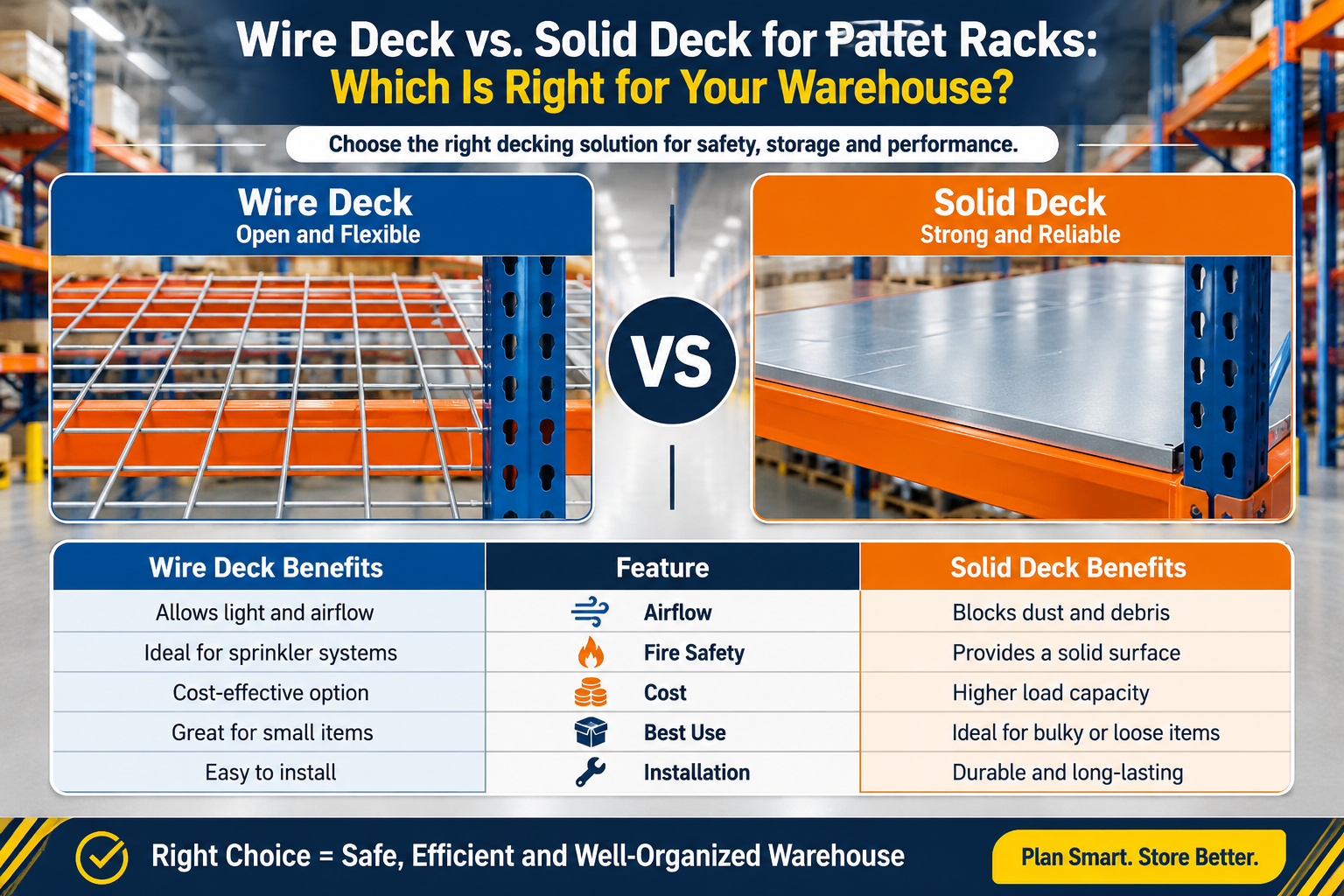
Wire deck vs. solid deck for pallet racks: compare safety, sprinkler compatibility, load support, and warehouse applications.
Why Pallet Rack Decking Matters
Pallet racks hold pallets directly on the beams, so many warehouses never add decking. That works for well-built pallets with solid bottom boards — but decking adds three things a bare rack can't. Browse our pallet rack accessories for wire decking, support bars, and related components.
Continuous Support Surface
Spreads the load across the beam pair and supports pallets that are damaged, non-standard, or smaller than the bay.
Safety Backup
Helps catch loose items and keeps a broken pallet from dropping straight through the rack opening.
Flexibility
A decked level can hold cartons, totes, drums, and loose goods that pallet rack alone cannot support.
Pallet Rack Decking Options at a Glance
Wire and solid steel dominate, but they aren't the only choices. Each bar shows the typical capacity range per level (scale: 0–6,000+ lbs UDL).
Wire Mesh Deck
Flared Channel Wire
Solid Steel Deck
Perforated Steel
Plywood / Particle Board
Pallet Support Bars
Capacity figures are typical ranges and vary by manufacturer, panel size, steel gauge, and beam spacing. Always confirm the exact rating from your supplier's engineering data before loading.
Benefits & Limitations: Each Deck Type
Wire Mesh Decking
Key Benefits
- Fire sprinkler compliance: open grid lets water reach lower levels, supporting NFPA 13 flue-space performance
- Visibility: see through to lower levels for faster inventory checks and better lighting
- Less dust and debris: debris falls through instead of collecting
- Lighter weight: lower dead load leaves more beam capacity for product
- Fast installation: most styles drop onto beams with no drilling or fasteners
Limitations
- Small items, loose cartons, and narrow goods can fall through
- No spill containment — liquids drip to levels below
- Rated for uniformly distributed loads; point loads can damage the mesh
- Standard finishes corrode in wet or freezer environments unless galvanized
Solid Steel Decking
Key Benefits
- Full-surface support for small parts, loose cartons, bagged goods, and irregular items
- Contains minor drips and keeps items from falling to lower levels
- Strong load distribution, with high ratings in heavier gauges
- Smooth surface that is easy to wipe down
Limitations
- Sprinkler obstruction: panels can block water from lower levels — a code and insurance problem unless in-rack sprinklers are provided
- Heavier — more dead load on your beams
- Blocks light and sightlines, making inventory checks harder
- Collects dust and debris; vulnerable to rust where the coating is scratched
Wire Deck vs. Solid Deck: Head-to-Head
The factors warehouse managers weigh most. The highlighted cell shows which option has the edge on that factor.
Fire Code & Insurance: The Factor Most Buyers Overlook
NFPA 13 assumes water can reach the fire. In rack storage, that water has to pass through the rack — including the decking — to reach lower levels. Depending on commodity class, storage height, and sprinkler design, solid decks may require in-rack sprinklers or may not be permitted at all.
Wire Mesh
Water reaches lower levels. Far more likely to comply.
Solid Steel
Water path interrupted. May need in-rack sprinklers.
- Identify your commodity class and storage height from your fire protection design documents.
- Ask your fire protection engineer whether solid decking is acceptable in your rack configuration.
- Check with your insurance carrier — some insurers set decking requirements beyond the minimum code.
- Confirm with your local Authority Having Jurisdiction (AHJ) if you are unsure.
- Document the approval so it is available during inspections or after an incident.
Weight Capacity: What Decking Does & Doesn't Change
A common misconception: adding decking increases what a rack level can hold. It doesn't. Capacity is still set by the beam pair and upright frame ratings. Decking distributes the load — it doesn't make the beams stronger — and every panel adds dead weight that comes out of your usable capacity.
Cost Comparison: What You'll Pay for Each Option
Pricing varies with panel size, gauge, finish, and order volume. Use the table as a starting point, then run your own numbers in the estimator.
Project Estimator
Panels = bays × decked levels × panels per level (commonly 2–3 per bay).
Which Decking Is Best for Your Application?
Pick your situation to see the recommendation.
Decking Mistakes That Create Safety & Compliance Problems
These errors show up regularly in warehouse audits and insurance reviews — each is easy to avoid with a little planning.
Solid deck without checking sprinkler design
Blocks water penetration; can violate NFPA 13 and void insurance coverage.
Ignoring deck dead weight
Deck weight reduces usable live load on every beam level.
Plywood as permanent decking
Unrated, combustible, and often not accepted by insurers.
Mixing deck brands or mismatched profiles
Poor fit on the beam step profile; unstable support.
Skipping pallet support bars
Pallets with broken boards can drop through or catch.
Concentrated point loads on wire deck
Wire deck is rated for uniformly distributed loads only.
Deck width that doesn't match beam depth
The deck can shift or sit unevenly, creating an unsafe surface.
How to Install & Maintain Rack Decking
Most wire decking installs simply, but doing it correctly protects both product and people.
Installation
- Confirm your beam profile (step beam, box beam, or structural channel) and match the deck style to it.
- Verify deck depth matches your upright frame depth so panels sit flush with no overhang or gap.
- Set each panel evenly across the beam pair, with support channels oriented per the manufacturer's instructions.
- Check that panels sit fully on the beam ledge — never partially supported.
- Add pallet support bars where recommended, and update the load placard to account for deck weight.
Ongoing Maintenance
- Include decking in regular rack inspections: look for bent channels, broken welds, sagging wires, and rust.
- Remove and replace any damaged panel immediately — never load a compromised deck.
Frequently Asked Questions
Wire deck vs. solid deck?
Wire deck is a welded steel mesh panel with open spaces that allow sprinkler water, light, and air to pass through. Solid deck is a flat or corrugated steel panel that provides a continuous surface for small items but blocks water penetration. Wire deck is the standard choice for palletized storage; solid deck suits small parts and cartons.
Required by fire code?
Fire codes don't mandate wire decking by name, but NFPA 13 requires adequate sprinkler water penetration through rack storage. Solid decking can block that water flow and cause violations. Open wire mesh is the most widely accepted decking because it maintains flue space performance. Always confirm requirements with your local fire marshal and insurer.
Does it add capacity?
No. Wire decking does not increase beam capacity — it distributes the load across the beam pair and supports the pallet surface. The rack's capacity is still governed by the beam and upright ratings. Wire deck adds dead weight (typically 15–35 lbs per panel), which should be subtracted from the usable live load.
How much can it hold?
Standard wire deck panels typically support 2,000–4,000 lbs of uniformly distributed load, while heavy-duty flared channel decks can reach 4,500 lbs or more. The exact rating depends on panel size, wire gauge, channel construction, and beam spacing. Always verify the manufacturer's capacity chart for your specific deck and beam combination.
Plywood on rack shelves?
Plywood is sometimes used as a budget option, but it is generally not recommended for commercial warehouses. It is combustible, often unrated for load capacity, and may not satisfy insurers or fire inspectors. Rated steel wire or solid decking is the safer, code-compliant choice for permanent installations.
Solid deck under sprinklers?
It depends on your sprinkler design, commodity classification, and rack configuration. Solid decks can block water from reaching lower levels, which may violate NFPA 13 unless in-rack sprinklers or other protections are provided. Consult a fire protection engineer and your insurance carrier before installing solid decking in any sprinklered rack system.
Pallet support bars?
Pallet support bars are steel crossbars that span between beams to support pallets with non-uniform bottom boards. They act as a safety backup if a pallet's boards break or if pallets are overhung. They're inexpensive and recommended on every pallet level, even when wire decking is installed.
Choosing wire deck size?
Match the deck depth to your upright frame depth and the deck width to your beam length. Common wire deck depths are 36, 42, and 48 inches; widths are typically 46 or 52 inches. Confirm the channel style fits your beam profile — step beam, box beam, or structural — before ordering.
Cold storage?
Yes, with the right finish. Galvanized wire decking resists condensation and corrosion in freezer and cooler environments, and its open design promotes airflow. Standard painted or powder-coated decks corrode faster in cold, humid conditions. Specify galvanized or zinc-coated decking for any cold storage application.
How long does it last?
With normal use and proper loading, wire decking commonly lasts 15 years or more. Lifespan shortens in corrosive environments, under chronic overloading, or after forklift damage. Inspect decks regularly for bent channels, broken welds, sagging wires, and rust, and replace any panel showing structural damage.
Not Sure Which Decking Fits Your Rack?
Pallet Storage Solutions supplies wire decking, pallet support bars, and rack accessories matched to your beam style and load requirements. Contact our team for a free quote and expert guidance on code-compliant decking for your warehouse.