
Transforming traditional selective pallet bays into carton flow racking enhances the speed and efficiency of both carton loading and picking compared to conventional shelving methods.
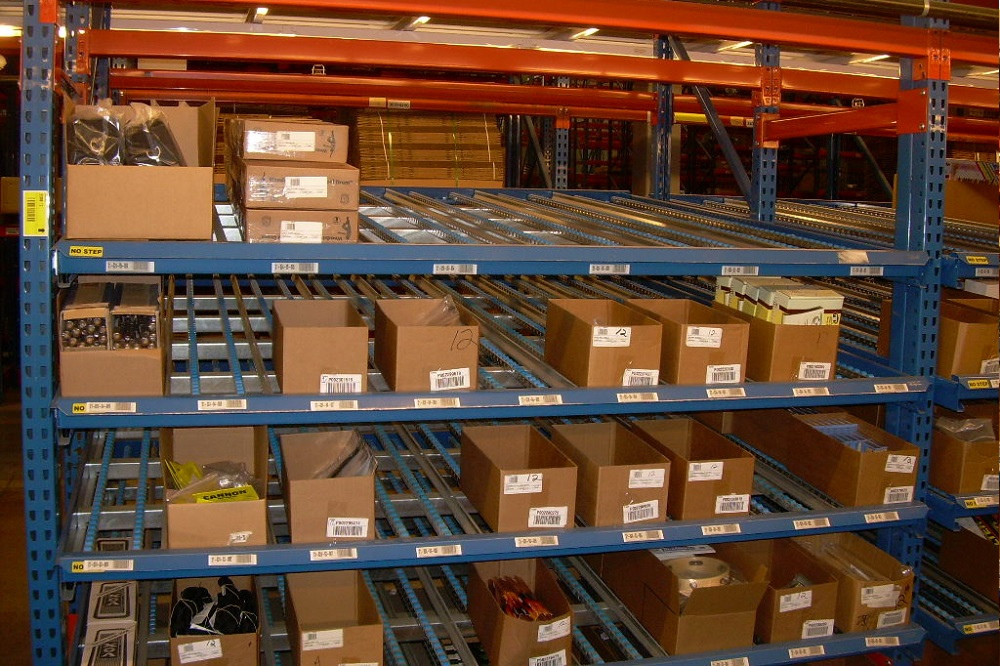
How Carton Flow Pallet Rack Works
Converting pallet rack bays into carton flow can be achieved by installing kits comprising slightly inclined lanes equipped with rollers or skate wheels. These components seamlessly integrate into standard bays, connecting with existing uprights or beams in selective pallet racks, often without the need for additional supports. Carton flow storage facilitates split-case or low-volume full-case picking, ideally suited for FIFO (first in, first out) stock management.
Stock cartons are loaded from the back of the rack and progress down the incline as each lane\’s cartons are emptied and removed. This arrangement ensures that stock remains easily accessible, eliminating the need for pickers to strain to reach into the rack. Moreover, the unnecessary labor involved in repositioning cartons on static shelving is eradicated.
A typical carton flow conversion in a standard pallet bay may accommodate around 25 different SKUs, depending on their sizes. Typically, each SKU occupies a single lane, and these lanes may extend the full depth of the pallet rack. Should one SKU exhibit higher activity than neighboring stock, it can expand to occupy adjacent lanes.
Overhead bays can retain their standard selective pallet rack configuration. Larger palletized overflow stock can be stored overhead and brought down by forklift for loading into carton flow lanes. The termination of each lane on the picking side may be level or forward-tilting. Tilting generally enhances the ease and efficiency of picking from broken cases, while a level shelf is usually preferred for picking larger, full cases.
📚 Also Read: Carton Flow Racks vs. Static Racking Which Is Better for You?
Benefits of Carton Flow Racking
The swift conversion of existing pallet racks to carton flow is achievable, offering numerous benefits:
- Carton flow conversion yields immediate labor savings of over 70%, resulting in significantly lower long-term costs compared to static storage systems due to increased productivity.
- Carton flow ensures better organization and accessibility of fast-moving stock for picking or inventory purposes.
- Typically, a carton flow configuration allows for storing more stock within the same square footage compared to static storage shelves.
- With pickers and stockers separated by the pallet rack, there is reduced foot traffic and congestion, minimizing interference between workers.
- Carton flow facilitates inventory control by providing easy visibility of carton stock along the inclined lane, simplifying counting and enabling at-a-glance inventory checks.
Drawbacks of Carton Flow Racking
The disadvantages of a carton flow rack may encompass:
- Other systems prove more efficient for high-volume, full-case storage and picking.
- Each case necessitates handling twice – initially by the loader and subsequently by the picker once the case is empty.
- Smaller, low-volume storage operations might perceive the initial cost of carton flow conversions as a deterrent compared to standard static storage.
- The presence of numerous moving rollers or wheels in a carton flow rack imposes regular maintenance demands to ensure the smooth operation of the system.
FAQ’s
How does carton flow pallet rack work?
Carton flow pallet rack utilizes slightly inclined lanes equipped with rollers or skate wheels. Stock cartons are loaded at the back of the rack and move down the incline as they are emptied and removed. This system ensures easy accessibility to stock and eliminates the need for manual repositioning of cartons.
What are the benefits of converting pallet racks to carton flow?
Converting pallet racks to carton flow offers several benefits, including immediate labor savings, improved organization and accessibility of stock, efficient space utilization, reduced congestion in the workspace, and enhanced inventory control.
Can carton flow racks accommodate different types of stock?
Yes, carton flow racks can accommodate various types of stock, including split-case or low-volume full-case items. Each SKU typically occupies a single lane, allowing for flexibility in storage configuration based on stock activity.
Are there any drawbacks to using carton flow racking?
While carton flow racking offers numerous advantages, some drawbacks include its suitability primarily for split-case or low-volume full-case picking, the need for double handling of cases, potential upfront costs for smaller storage operations, and regular maintenance requirements due to moving components.
How does carton flow racking compare to other storage systems?
Carton flow racking excels in improving picking and loading efficiency compared to conventional shelving methods. However, other systems may be more suitable for high-volume, full-case storage and picking scenarios. The choice depends on specific operational requirements and preferences.
Conclusion
Carton flow racking offers an efficient solution for enhancing carton loading and picking processes. Converting traditional pallet racks into carton flow systems can result in immediate labor savings, improved stock organization, and optimized space utilization. While there are some drawbacks to consider, such as maintenance requirements and suitability for specific picking scenarios, the overall benefits make it a compelling option for warehouse optimization. Ultimately, the decision to adopt carton flow racking depends on each business’s unique needs and priorities.