Pallet Storage Solutions

How to Maximize Vertical Space in a Warehouse | Pallet Storage Solutions
20%
Warehouse Space Optimization Series

Maximize
Vertical Space
in Your Warehouse

Most warehouses use only 20โ€“25% of their available cubic capacity. The floor is packed. The ceiling is empty. This guide shows you how to unlock what's already there โ€” without adding a single square foot.

20โ€“25%
Average cubic capacity used
That means 75โ€“80% of your warehouse's vertical volume is empty right now โ€” ready to be converted into pallet positions without any building expansion.
40 ft
VNA rack max height
100 ft+
ASRS system height
18 in
NFPA 13 sprinkler clearance
5โ€“6 ft
VNA minimum aisle width
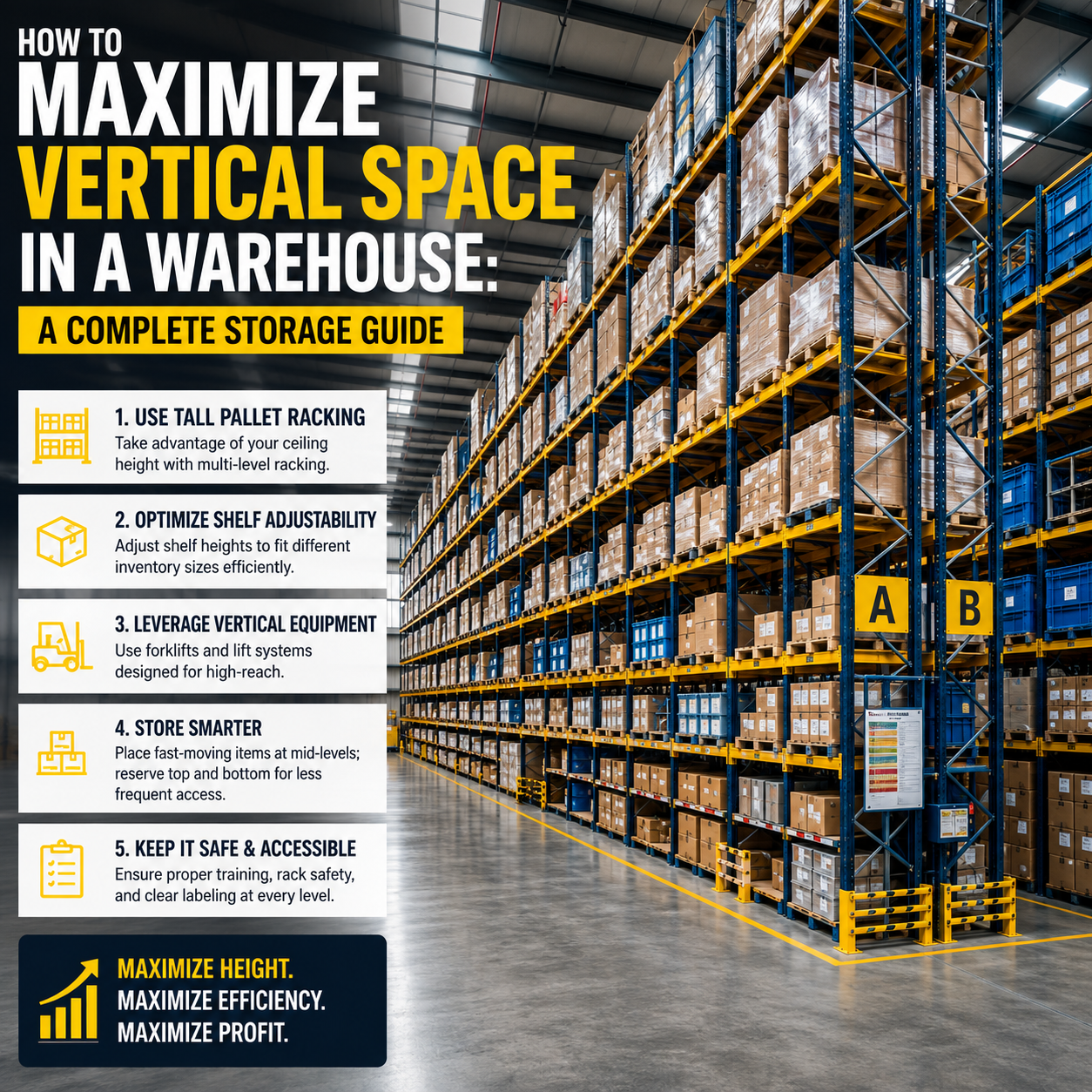
high bay warehouse pallet racking system maximizing vertical storage space with multiple rack levels
Section 01

Start Here: Understanding Your
Usable Ceiling Height

Before you can plan any vertical storage upgrade, you need one number: your clear ceiling height โ€” not the height to the roof deck, but the height to the lowest overhead obstruction. The number you get is your true planning height.

Different areas of your warehouse may have different effective heights. Measure each zone independently and use the most restrictive measurement when selecting rack height for that zone.

โš  Common Overhead Obstructions
๐Ÿ”ฅFire sprinkler lines & heads (NFPA 13: 18" clearance above stored goods)
๐Ÿ’กLighting fixtures โ€” especially older fluorescent bay lighting
๐ŸŒ€HVAC ductwork and refrigeration lines
๐Ÿ—Roof structure beams, trusses, or purlins
๐ŸšชOverhead doors and dock leveler mechanisms near loading areas
๐Ÿ“Š Clear Ceiling Height โ†’ Storage Strategy
Under 14 ft
Single-level selective
1โ€“2
Levels
14โ€“18 ft
Standard selective 2โ€“3 levels
2โ€“3
Levels
18โ€“24 ft
3โ€“4 level selective racking
3โ€“4
Levels
24โ€“30 ft
High-bay + reach truck
4โ€“5
Levels
30โ€“40 ft
Narrow aisle / VNA
5โ€“7
Levels
40 ft+
ASRS or high-bay VNA
7โ€“10+
Levels
Section 02

Choosing the Right Racking System
for Vertical Optimization

Not all racking systems are equally effective at unlocking vertical space. The system you choose determines how high you can go, what equipment you'll need, and how much aisle space you trade for vertical density.

Good
Standard Selective
Up to 40 ft
Aisle: 11โ€“13 ft (counterbalance forklift)
Vertical Efficiency
General warehousing, mixed SKUs. Most common starting point for vertical upgrades.
Excellent
Narrow Aisle (VNA)
Up to 40+ ft
Aisle: 5โ€“6 ft (wire-guided turret truck)
Vertical Efficiency
High-SKU distribution centers. Maximum height with minimum aisle footprint.
Very High
Drive-In / Thru
Up to 35 ft
Aisle: One aisle per block
Vertical Efficiency
Single-SKU, high-volume LIFO storage. Eliminates most cross-aisle travel.
High
Push-Back Rack
Up to 30 ft
Aisle: One aisle per row
Vertical Efficiency
2โ€“5 deep LIFO storage. Good balance of density and accessibility.
High
Pallet Flow
Up to 30 ft
Aisle: Two aisles per block
Vertical Efficiency
FIFO perishables and high-velocity SKUs. Gravity-fed automatic product rotation.
Maximum
Mobile Racking
Up to 35 ft
Aisle: One shared mobile aisle
Vertical Efficiency
Maximum storage density. Ideal for cold storage โ€” highest vertical and floor efficiency combined.
Very High
Double Deep
Up to 35 ft
Aisle: 9โ€“10 ft (reach truck)
Vertical Efficiency
Medium density, fewer SKUs. Doubles pallet depth without specialized equipment cost.
Good for Type
Cantilever
Up to 30 ft
Aisle: Open face aisle
Vertical Efficiency
Long goods, lumber, pipe, and steel. Unique vertical use case โ€” optimized for shape, not density.
Section 03 ยท Most Impactful Upgrade
The Case for Narrow Aisle Racking
For warehouses with 24+ foot ceilings currently using standard selective racking with counterbalance forklifts, the single most impactful vertical optimization is converting to a narrow aisle system. The math is compelling โ€” less floor dedicated to travel means more floor for rack rows.
Standard Aisles
12 ft
~50%
Narrow Aisle
8 ft
~35%
Very Narrow Aisle
5โ€“6 ft
<20%
โ†‘ % of floor used for travel aisles. Lower = more space for rack rows.
The ROI Calculation
Equipment Cost vs.
Lease Alternative
The tradeoff is equipment cost. But measured against leasing additional warehouse space, the payback period is often under 24 months.
Cost Comparison
Reach trucks: $25,000โ€“$50,000
VNA turret trucks: $80,000+

Additional warehouse lease in most US markets:
$8โ€“$15/sq ft per year

For 5,000 sq ft of additional space: $40Kโ€“$75K/year โ€” every year, indefinitely. One equipment purchase eliminates the need permanently.
Section 04

High-Bay Pallet Racking:
Going Taller with Existing Systems

If your warehouse has untapped ceiling height above your current rack system, two approaches can unlock it โ€” each suited to a different situation and budget.

Method 01 ยท Fastest
Adding Beam Levels to Existing Uprights

If your current uprights have unused height above the top beam, adding another beam level is inexpensive and fast. The cost is primarily the beams themselves plus installation labor.

โ†’Confirm upright frame capacity has not been reached โ€” check your load placard first
โ†’Verify beam spacing will accommodate your tallest pallet load on every level, not just the top
โ†’Maintain 18-inch minimum clearance to sprinkler heads above the new top level
Typical Cost
Beam pair (per pair)$100โ€“$300
Installation laborVaries
Total project rangeLow Cost
Method 02 ยท More Involved
Replacing Uprights for Greater Height

When your current uprights are already at or near their top, replacing them with taller frames unlocks an entirely new tier of storage. More involved, but significantly less costly than building expansion.

โ†’Rack must be partially disassembled during the upright replacement process
โ†’Floor anchors may need replacement to meet new upright engineering specs
โ†’New system requires a fresh load assessment and updated load placards
Typical Cost vs. Alternative
20-bay upright replacement$8Kโ€“$20K
5,000 sq ft lease per year$40Kโ€“$75K
Year-1 savings$20Kโ€“$55K
Section 05

Mezzanine Platforms: Creating a
Second Floor Inside Your Warehouse

A mezzanine creates an entirely new floor level inside your existing building envelope, doubling the usable space in a given footprint area โ€” without any structural changes to the building itself.

Type A
Rack-Supported Mezzanine
Built on existing pallet rack uprights
Load Capacity
125 lbs/sq ft
Small parts, pick modules, bin storage above rack system
Type B
Steel Column-Supported
Standalone steel columns โ€” independent of racking
Load Capacity
250โ€“1,000 lbs/sq ft
Heavy inventory, office space above warehouse floor
Type C
Shelf-Supported
Built on industrial shelving systems
Load Capacity
Up to 100 lbs/sq ft
Light goods, order picking, archive storage
Type D
Catwalk / Crossover
Walkway bridging rack rows at height
Load Type
Foot Traffic
Access to upper rack levels without a personnel lift
โš  Key Considerations Before Installing
๐Ÿ—
Floor Load CapacityYour concrete floor must support the mezzanine columns' point loads. Get a floor slab assessment before any commitment is made.
๐Ÿ“‹
Building PermitsMost jurisdictions require a permit for mezzanine installation. Budget for permit drawings and local AHJ approval time โ€” typically 2โ€“6 weeks.
๐Ÿ”ฅ
Sprinkler CoverageAdding a mezzanine may require additional fire sprinkler heads both below and above the new platform level to maintain NFPA 13 compliance.
๐Ÿชœ
Access EquipmentOSHA requires stairways for personnel access. Vertical lifts or conveyors may be needed for goods movement to and from the platform.
๐Ÿ–ผ๏ธ
Mezzanine Install Photo
Section 06 ยท Advanced

ASRS: The High-Bay Future
for Large-Scale Distribution

Automated Storage & Retrieval
When 40+ Feet Is
the Starting Point

For large-scale distribution centers with ceilings above 40 feet, ASRS uses automated cranes, shuttles, or robotic systems to store and retrieve pallets at heights that no human-operated forklift can safely reach โ€” achieving storage densities that would be impossible with any conventional racking approach.

100+
Feet of height possible in purpose-built high-bay facilities
$1M+
Minimum capital investment for ASRS installations
60 ft
Common ASRS installation height in standard DCs
24/7
Automated retrieval without operator limitations
Important Limitations
Not right for every operation:
๐Ÿ’ฐ
High Capital Cost: $1Mโ€“$10M+ depending on scale, SKU count, and throughput requirements. Not viable for most mid-size operations.
๐Ÿ”ง
Specialized Maintenance: Automated systems require dedicated maintenance programs and specialized technicians not available in all markets.
๐Ÿ“ฆ
Best with Consistent Inventory: Works best with high-volume, consistent inventory profiles. Variable or irregular SKU mixes reduce system efficiency significantly.
๐Ÿ—
Purpose-Built Facilities: Often requires building design around the ASRS system โ€” not typically retrofitted into standard warehouse structures.
Bottom line: For large US distribution centers running high SKU volumes with predictable throughput, ASRS represents the most complete use of vertical space available. For most warehouse operations, high-bay selective or VNA racking delivers superior ROI at a fraction of the cost.
Discuss Your Options โ†’
Section 07

Slotting Strategy: Making
Vertical Space Work Operationally

The best-designed vertical racking system delivers poor results if products are slotted in the wrong locations. Vertical space optimization is not just a structural project โ€” it's an operational one.

๐Ÿ“ฆ ABC Velocity Slotting โ€” Visual Zone Map
C
๐Ÿ“ฆ
C Items โ€” Top Levels
Slowest movers ยท Lowest pick frequency
~50%
C
๐Ÿ“ฆ
C Items โ€” Upper Storage
Can tolerate additional access time
of SKUs
B
๐Ÿ“ฆ
B Items โ€” Mid Levels
Reach truck accessible ยท Medium velocity
~30%
B
๐Ÿ“ฆ
B Items โ€” Secondary Pick
Beam levels 2โ€“3 from ground
of SKUs
A
๐Ÿ”ฅ
A Items โ€” Ground Level
Fastest access ยท No lift needed
~20%
๐Ÿ“Š
ABC Velocity Slotting
A Items
Top 20% by pick frequency. Ground level and primary pick positions โ€” fastest access, no lifting equipment needed. +15โ€“25% pick speed improvement.
B Items
Middle 30%. Store at beam levels 2โ€“3, accessible by reach truck but not occupying prime floor-level positions.
C Items
Bottom 50% by pick frequency. Move to the highest rack levels โ€” slowest movers can tolerate the additional access time.
โš–๏ธ
Weight-Based Vertical Slotting
Heavy
Dense, heavy inventory belongs at lower levels. Lower beam levels carry higher loads to the floor more efficiently โ€” and reduce risk from heavy items at height.
Light
Light, bulky items โ€” foam, packaging, large-volume but low-weight SKUs โ€” are ideal candidates for upper rack levels where the weight advantage is most valuable.
Get a Custom Slotting Plan โ†’
Section 08

6 Costly Vertical Storage Mistakes
US Warehouses Make

These are the most common โ€” and most avoidable โ€” errors that derail vertical storage projects. Each one has a direct, documented cost.

Mistakeโš  What It Costs Youโœ… The Fix
Ignoring Sprinkler Clearance
โšก NFPA 13 violation risk
Fire suppression failure, failed inspection, potential rack removal order
โœ… Maintain 18" clearance below sprinkler heads โ€” always, at every level
Forgetting Forklift Turning Radius at Aisle Ends
โšก Safety incident risk
Aisle blockages, rack damage from turning impacts, OSHA citations for unsafe travel zones
โœ… Add end-of-aisle clearance to your layout before purchasing racks
Stacking Beams Too Close to Ceiling
โšก Wasted top level
No room for tall pallet loads or load height variations โ€” top level becomes unusable
โœ… Factor in tallest pallet load + 6" clearance above + 18" sprinkler gap
Using Standard Racks in Seismic Zones
โšก IBC/ANSI non-compliance
Building code violation, collapse risk, insurance liability, potential facility shutdown
โœ… Get site-specific seismic engineering before installing any high-bay racks
Mixing Upright Heights in Same Aisle
โšก Load distribution issues
Uneven load distribution, visual confusion for operators, difficult maintenance planning
โœ… Keep upright heights consistent within a rack row
Buying Racks Before Measuring Clear Height
โšก Wasted investment
Rack system doesn't fit, unusable top levels, complete redesign required at additional cost
โœ… Measure floor to lowest ceiling obstruction โ€” not the roofline โ€” before quoting
Section 09

How to Get Started: A Step-by-Step
Vertical Storage Plan

Whether outfitting a new facility or optimizing an existing one, the path to maximizing vertical space follows the same sequence. Each step builds on the last โ€” skipping any one creates gaps that cost you later.

1
Step 01 ๐Ÿ“
Measure True Clear Ceiling Height
Measure from finished floor to lowest overhead obstruction in each zone. Account for sprinklers, lighting, HVAC, and structural beams โ€” not the roofline figure on your lease.
2
Step 02 ๐Ÿ—บ
Audit Current Storage Layout
Calculate your current pallet positions, vertical space utilization percentage, and where the biggest capacity gaps are. You can't optimize what you haven't measured.
3
Step 03 ๐Ÿ”
Assess Racking & Equipment
Can your uprights go taller? Are your forklifts limiting your reach height? What's the rated column load on your current frames? These determine your upgrade path.
4
Step 04 ๐Ÿ“ฆ
Identify Your Storage Profile
SKU count, load uniformity, FIFO vs. LIFO requirements, and pick frequency distribution all determine which racking system type delivers the best vertical ROI for your operation.
5
Step 05 ๐Ÿ—
Get a Professional Design Consultation
A racking specialist can model multiple layout options โ€” often at no cost โ€” and show you the pallet position gains achievable within your specific budget and ceiling constraints.
6
Step 06 ๐Ÿ“ˆ
Phase the Investment
Add beam levels first. Replace one row of uprights. Add a mezzanine later. Phased investment spreads cost while delivering early capacity gains โ€” and pairs with a new slotting plan at each phase.
Not sure how much vertical capacity your warehouse is leaving on the table?
We offer free warehouse layout consultations for US warehouse operators โ€” custom vertical storage plans built for your facility and budget.
Get a Free Consultation โ†’
Section 10

Frequently Asked
Questions

Ceiling Height
Racking Systems
Equipment
Mezzanines
Costs & ROI
Start by measuring your clear ceiling height and identifying the lowest obstruction โ€” beams, lighting, or sprinklers. Then select a racking system that reaches within safe clearance of that point. High-bay selective racks, narrow aisle systems, and mezzanines are the most effective tools for unlocking vertical storage capacity.
For standard pallet racking operations, 24โ€“32 feet of clear ceiling height is considered optimal โ€” allowing 4โ€“6 pallet levels with room for forklift mast clearance. Anything below 18 feet limits vertical efficiency significantly. Facilities over 30 feet benefit most from narrow aisle or automated storage systems.
Very Narrow Aisle (VNA) racking systems with wire-guided turret trucks offer the greatest combination of height and density โ€” reaching 40+ feet with minimal aisle space. For facilities where automation isn't practical, high-bay selective racking with reach trucks provides the best balance of vertical reach and accessibility.
Standard selective pallet racks typically reach 20โ€“40 feet depending on upright gauge and engineering specs. Very Narrow Aisle and automated systems can exceed 100 feet in purpose-built high-bay facilities. In all cases, height limits are governed by local building codes, seismic requirements, and fire suppression clearance rules.
NFPA 13 generally requires a minimum 18-inch clearance between the top of stored goods and the nearest sprinkler deflector. This means your highest rack load must sit at least 18 inches below the sprinkler heads โ€” a critical calculation often missed when purchasing racks to maximize ceiling height.
A warehouse mezzanine is an elevated platform installed above ground-level storage, effectively creating a second floor inside your facility. Use one when you need to expand storage or workspace without extending your building footprint. They're ideal for light parts, order picking areas, or office space above the warehouse floor.
Almost always cheaper to go vertical. Adding beam levels to existing uprights costs a fraction of new construction, leasing additional space, or building an expansion. Even purchasing an entirely new high-bay racking system is typically far less expensive per pallet position than expanding square footage.
Yes. Standard counterbalance forklifts are limited to approximately 15โ€“20 feet of lift height. High-bay racking above 20 feet requires a reach truck, order picker, or turret truck depending on the aisle width. Equipment selection must be confirmed before purchasing a high-bay rack system.
VNA (Very Narrow Aisle) racking uses the same selective rack structure as standard systems but with aisles as narrow as 5โ€“6 feet, serviced by wire-guided or rail-guided turret trucks. It's ideal for high-SKU distribution centers with 30+ foot ceilings. The tradeoff is higher equipment cost and the need for a flat, smooth floor surface.
Divide your clear ceiling height by the vertical space each pallet level requires โ€” typically pallet height plus beam height plus clearance (roughly 4โ€“5 feet per level). Subtract 18 inches for sprinkler clearance at the top. The result gives you usable beam levels per bay, multiplied by your total rack bays for total pallet positions.
Scroll to Top