Pallet Storage Solutions

Cold Storage Pallet Racking: Best Systems for Freezer Warehouses | Pallet Storage Solutions
❄ Cold Chain & Specialized Storage
Freezer & Refrigerated Warehouses
-20°F to +75°F Applications
❄️ Cold Storage Racking Series · 2025

Cold Storage
Pallet Racking:
Best Systems
for Freezer
Warehouses

Cold storage is not a standard warehouse with the thermostat turned down. Condensation, steel embrittlement, floor heave, and energy costs that scale with every cubic foot of refrigerated air you maintain — this guide covers what actually matters.
❄ Temperature Zone Reference
Ambient / Dry
🌡
55–75°F
Refrigerated Cooler
🧊
33–55°F
Blast Chilling
💨
0–33°F
Frozen / Freezer
❄️
-10–32°F
Deep Freeze
🔵
Below -20°F
60–115%
More pallet positions: drive-in vs. selective in same freezer footprint
30–40%
Refrigerated volume reduction with mobile racking vs. standard layout
$60K/yr
Max annual energy savings achievable with mobile racking in a 10,000 sq ft freezer
2–5 yrs
Typical lifespan of standard racks installed without red-storage specification

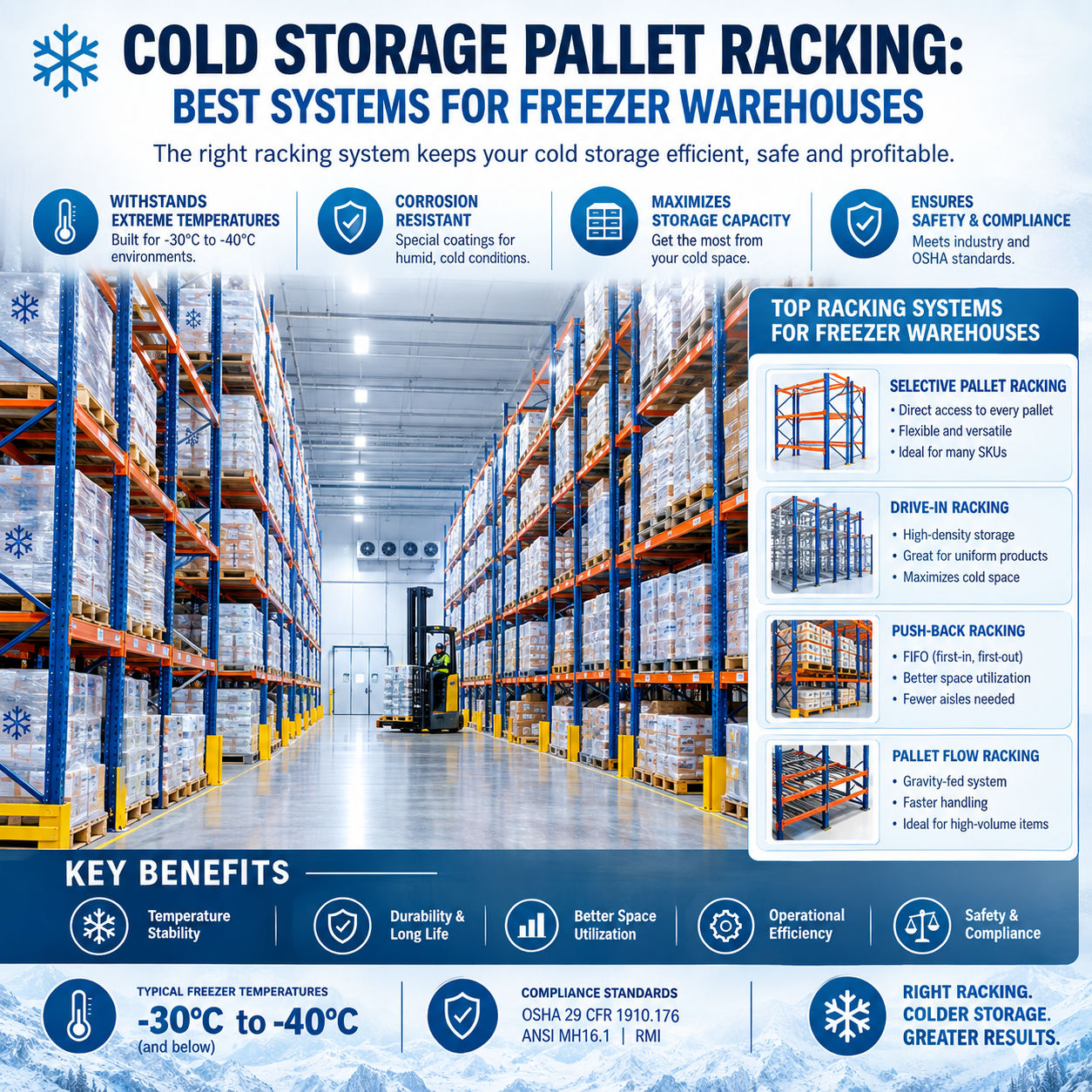
Cold storage pallet racking designed for freezer and refrigerated warehouses, with a focus on storage density, corrosion resistance, and energy efficiency.

Section 01

Cold Storage Temperature Zones:
What Each Demands

Your temperature zone determines which racking materials, finishes, and systems are appropriate. Using the wrong specification for your temperature range is the most common — and most expensive — red storage racking mistake.

Zone & Temperature
Typical Products
Key Racking Concern
Specification Required
Ambient / Dry Storage
55–75°F
13–24°C
Canned goods, dry food,
general retail products
No special requirements — standard racking fully adequate
Standard Powder Coat
No Cold Spec Needed
Refrigerated Cooler
33–55°F
1–13°C
Fresh produce, dairy,
beverages, deli meats
Condensation control essential — corrosion begins here
Heavy-Duty Powder Coat
or Electro-Galvanized
Blast Chilling
0–33°F
-18–1°C
Meat processing, ready
meals in transition
Rapid thermal cycling — structural fatigue risk from expansion and contraction
Hot-Dip Galvanized
or Zinc-Rich + Epoxy
Frozen / Freezer
-10–32°F
-23–0°C
Ice cream, frozen meals,
seafood, meat
Steel embrittlement at low temps + floor heave risk if slab not properly engineered
Hot-Dip Galvanized
+ Cold-Duty Steel Spec
Deep Freeze
Below -20°F
Below -29°C
Long-term frozen storage,
pharmaceuticals
Maximum corrosion resistance + heated floor slab required — most demanding specification
Hot-Dip Galvanized
or Stainless Steel
⚠️
Key principle: The colder the environment, the more aggressive the material and finish specification required. Never apply ambient or standard cooler rack specifications to a true freezer environment — standard racks in red storage environments fail within 2–5 years.
Section 02

Why Cold Storage Racking Is Not
the Same as Standard Warehouse Racking

Three specific failure mechanisms make red storage a fundamentally different engineering problem. Each one is invisible in the planning phase — and expensive to discover after installation.

💧
Failure Mechanism 01
Condensation
& Corrosion
Every time warm, humid air enters a cooler or freezer through open doors or loading operations, moisture condenses on rack surfaces. In wash-down environments, cleaning chemicals accelerate the process dramatically.

Corrosion doesn't just look bad — it actively degrades structural capacity. A rack engineered for 4,000 lbs with intact steel may carry significantly less once corrosion compromises the column wall thickness.
⚡ Consequence if ignored
Standard powder coat fails within 12–24 months in a true freezer environment — structural degradation follows.
🔩
Failure Mechanism 02
Steel Brittle-
ness at Low
Temperatures
Steel becomes more brittle at very low temperatures — the ductile-to-brittle transition. In standard warehouse conditions, steel bends before it breaks, giving visible warning. At deep freeze temperatures, the same steel can fracture suddenly under a forklift impact with little visible deformation beforehand.

This is why reduty racking uses steel specifications designed for low-temperature service, and why post-impact inspections in freezer environments require immediate professional assessment.
⚡ Consequence if ignored
Sudden fracture failure under impact — without the warning signs you'd see in ambient warehouse conditions.
🏗
Failure Mechanism 03
Freezer
Floor Heave
When a freezer slab sits on uninsulated or under-heated subgrade, ground steel penetrates beneath the concrete and causes it to expand upward. This movement directly affects rack anchor integrity: base plates lift, anchor bolts crack their embedment, and rack columns lean or buckle.

Prevention requires a properly engineered freezer floor with sub-slab insulation, a heating system, or both. Retrofitting a heave-damaged floor with an active rack system in place is enormously expensive.
⚡ Consequence if ignored
Upright base plates lift off the floor, anchor bolts pull — catastrophic rack failure risk.
Section 03

Best Pallet Racking Systems for
Cold Storage: Full Comparison

Every major racking system can be adapted for cold storage with the correct material specifications — but they are not equally suited to the demands of frozen and refrigerated environments. For a broader comparison of system types, see our guide on selective vs. drive-in vs. push-back racking.

Racking SystemCold Storage SuitabilityKey AdvantageKey LimitationBest Cold Application
Excellent
Full pallet access; easiest to maintain and inspect
Wide aisles reduce storage density
Coolers, mixed SKUs, pharma red storage
Ideal
Maximum density; minimal aisle heat loss
LIFO only; requires uniform pallet size
Deep freeze, single-SKU frozen storage
Drive-Thru Rack
Excellent
FIFO rotation in dense format
Requires two access aisles — more heat loss
Perishable frozen goods, dairy FIFO
Pallet Flow (Gravity)
Excellent
FIFO with gravity feed; low labor
Higher cost; roller maintenance in freeze
Fresh produce, FIFO perishable frozen
Push-Back Rack
Good
LIFO density without entering the rack
Mechanical components need red-grade lubrication
Frozen goods with multiple SKU lanes
Mobile Pallet Rack
Ideal
Maximum density + FIFO; one moving aisle
Highest cost; floor must be perfectly flat
Cold storage expansion, pharma freezers
Double Deep Rack
Good
Moderate density without full drive-in
Requires double-deep reach truck; LIFO
Coolers with reach truck fleets already
💡
Specification reminder: Every system in this table requires cold-duty material and finish specification for freezer environments. The star ratings reflect cold storage suitability — not absolute performance rating. A drive-in rack with standard powder coat in a -10°F freezer will fail. A drive-in rack with hot-dip galvanized finish is the density champion for frozen storage. Always verify pallet rack weight capacity for your specific loads and temperature zone.
Section 04

Drive-In Racking in Freezer Warehouses:
The Density Champion

// DRIVE-IN LANE — TOP-DOWN VIEW (8 pallets deep)
P8
P7
P6
P5
P4
P3
P2
P1 ←
Level 4
📦
📦
📦
📦
📦
📦
📦
📦
Level 3
📦
📦
📦
📦
📦
📦
📦
📦
Level 2
📦
📦
📦
📦
📦
📦
🚜
Ground
📦
📦
📦
📦
📦
📦
📦
60–115%
More pallet positions vs. selective rack in same footprint
8–10
Optimal lane depth for maximum freezer density
LIFO
Last-In, First-Out — ideal for single-SKU frozen storage
1
Entry aisle per lane — minimizes warm-air infiltration
For pure frozen storage — single or limited SKU count, LIFO inventory rotation, and maximum pallet density — drive-in racking is the dominant choice in US freezer warehouses. Every aisle eliminated is a volume of refrigerated air that no longer needs to be cooled and maintained. Explore our full range of pallet racking systems for cold storage applications.
Lane Depth: The Density vs. Access Trade-off
Deeper lanes (8–10 pallets deep) maximize density but reduce SKU accessibility. Shallower lanes (4–6 deep) offer a compromise between density and product rotation flexibility. Model both against your SKU count before committing.
Fewer Entry Aisles = Direct Energy Savings
Fewer entry aisles mean less warm-air infiltration during loading and picking operations — a direct energy efficiency advantage that compounds over the lifetime of the system.
Pallet Uniformity Is Non-Negotiable
Drive-in systems require consistent pallet dimensions and load heights. Non-uniform pallets create blocking and damage risks inside the rack lane — verify your pallet profile before committing to drive-in design.
Cold-Duty Rail Finish Throughout
The horizontal pallet support rails inside the rack must be galvanized or epoxy-coated along with the uprights and beams. It's a common oversight to spec only the visible structural elements.
Section 05

Mobile Pallet Racking:
The Energy-Efficiency Leader

Mobile racking moves the aisle to you — instead of fixed aisles between every row, one aisle moves to whichever row is being accessed. The rest closes up. In a freezer, this is transformational.

Selective Racking
10,000 sq ft Freezer
Aisles 50%
Storage 50%
~50% of refrigerated floor volume is air you're paying to keep frozen but not storing product in
📊
45–55% of floor space = refrigerated aisles — every cubic foot costs energy
💸
Cooling cost per pallet position is high because refrigerated volume is largely wasted air
🕐
Energy bill scales with every open aisle — whether it's accessed 100 times a day or once a week
Mobile Racking
Same 10,000 sq ft
12%
88% Storage
10–15% aisle space — 30–40% refrigerated volume reduction vs. standard layout
One moving aisle serves the entire rack system — only open when access is needed
📈
Storage density increase of 30–50% in same footprint — more pallets, less refrigerated air
FIFO rotation possible — accessible in sequence as the aisle moves row to row
Annual Energy Savings Potential
$15K–$60K
For a medium-sized US freezer at $0.12–$0.18 per kWh. Full payback on the mobile racking premium often achieved within 3–5 years.
⚙ Mobile Racking Cold Storage Requirements
Exceptionally flat floor — F-number spec must meet carriage system requirements
Sub-floor heating to prevent ground steel affecting floor flatness and rail alignment
Cold-duty drive motors and control electronics rated for operating temperature
Hot-dip galvanized or equivalent rack finish throughout — no standard powder coat
Emergency stop systems and aisle entry sensors rated for red environment
Annual inspection of carriage system, rails, and drive mechanism by specialist
Section 06

Corrosion Protection: Choosing the
Right Rack Finish for Your Zone

The finish specification on your red storage racking is not a cosmetic decision — it's a structural longevity decision. Here's a complete comparison of every option available in the US market.

Standard
Standard Powder Coat
Electrostatic powder coating, baked on
Cold Protection
Durability
Wash-down OK
Cost vs. Standard
Baseline (0%)
Ambient / dry storage only — not suitable for refrigerated or frozen environments.
Heavy-Duty
Heavy-Duty Powder Coat
Thicker coat, enhanced edge coverage
Cold Protection
Durability
Wash-down OK
Cost vs. Standard
+5–10%
Coolers (33–55°F) with dry airflow. Not adequate for true freezer environments or wash-down.
Hot-Dip Galv.
Hot-Dip Galvanized
Steel dipped in molten zinc bath — zinc bonds to steel at molecular level
Cold Protection
Durability
Wash-down OK
Cost vs. Standard
+20–35%
Wet coolers, wash-down environments, freezer warehouses. Industry standard for red storage.
Zinc + Epoxy
Zinc-Rich Primer + Epoxy
Two-coat system — zinc primer, industrial epoxy topcoat
Cold Protection
Durability
Wash-down OK
Cost vs. Standard
+15–25%
Freezers, food-grade environments. Strong alternative to hot-dip galvanized for most red storage applications.
Stainless
Stainless Steel
Grade 304 or 316 stainless steel construction throughout
Cold Protection
Durability
Wash-down OK
Cost vs. Standard
+150–300%
Pharmaceutical, clean-room, severe wet-freeze. Justified where chemical resistance is also required.
Electro-Galv.
Electro-Galvanized
Zinc electroplating — thinner zinc layer than hot-dip
Cold Protection
Durability
Wash-down OK
Cost vs. Standard
+10–15%
Light-duty cooler shelving. Not recommended for true freezer environments or heavy wash-down.
Our recommendation: For most US freezer warehouse applications, hot-dip galvanized or zinc-rich primer with epoxy topcoat represents the best balance of protection, durability, and cost. Stainless steel is justified in pharmaceutical, clean-room, or severe wet-freeze environments where chemical resistance is also a requirement alongside corrosion resistance.
Section 07

Forklift & Equipment Requirements
for Cold Storage Racking

Your racking system choice determines your equipment requirement — and in red storage, the equipment specification has an additional layer: reduty ratings. Standard forklifts are not designed for sustained operation in freezer temperatures.

Equipment Type
Cold-Duty Available?
Freezer Ready?
Counterbalance Forklift
Standard limit: 32°F
Yes — Cold Spec
Yes with Cold Rating
Reach Truck
Standard limit: 32°F
Yes — Cold Spec
Yes with Cold Rating
Electric Pallet Jack
Standard limit: 14°F
Yes — Deep Freeze Model
Yes with Deep Freeze Model
Turret Truck (VNA)
Standard limit: 32°F
Yes — Cold Spec
Yes with Cold Rating
AGV / Automated Systems
Varies by model
Some Models — Verify
Verify per Model
Standard Forklift (non-rated)
No reduty spec
Not Available
Do Not Use in Freezer
🔧 Cold-Duty Equipment Features
🏠
Insulated Cab: Operator warming system or fully enclosed heated cab for sustained freezer access
🛢
Cold-Grade Hydraulic Oil: Formulated to maintain viscosity at sub-zero temperatures — standard oil thickens and fails
🔋
Battery Heater Blanket: Prevents capacity loss in red environments — standard batteries lose up to 50% capacity at freezer temps
💻
Condensation-Resistant Electronics: Sealed control panels and moisture-resistant wiring for thermal cycling environments
🔩
Cold-Grade Lubricants: Grease and lubricants rated for sub-zero service throughout all moving components
⚠️ Cold-duty equipment typically costs 10–20% more than standard versions — but equipment failures in a -10°F freezer create both operational disruption and genuine worker safety risks. Never use standard-spec forklifts in true freezer environments.
Section 08

7 Cold Storage Racking Mistakes
That Cost US Warehouses Dearly

Cold storage racking projects go wrong in predictable ways. These are the mistakes that show up repeatedly in facilities that end up replacing racks ahead of schedule.

01
Using Standard Powder-Coated Racks in a Freezer
Ordering general-purpose racks without specifying red storage — often to save 20–35% on upfront cost.
Corrosion Within 12–24 Months
Rack structural degradation, emergency replacement, and downtime — total cost far exceeds the saved upfront amount.
02
Ignoring Floor Heave in Freezer Slabs
Assuming standard concrete slab is adequate for a freezer without verifying sub-slab insulation and heating.
Anchor Bolts Pull — Catastrophic Risk
Upright base plates lift off the floor as the concrete heaves, anchor bolts pull from embedment — structural failure risk.
03
Choosing Wide-Aisle Without Energy Analysis
Designing for equipment convenience without modeling the refrigerated volume impact of large aisle spaces.
Energy Costs Surge — Every Year
Excessive red air loss from large aisle volumes — a recurring annual cost that compounds over the building's lifetime.
04
Forgetting Forklift Cold-Weather Ratings
Using standard forklift spec without reduty rating — often because the equipment was already on hand.
Battery Failure + Safety Incidents
Battery failure in freezer temps; hydraulic fluid thickening; condensation in electronics — all creating real safety hazards.
05
No Condensation Management Plan
Overlooked during the design phase — treated as an operational concern rather than a design specification.
Ice Buildup + Slip Hazards
Ice accumulation on rack uprights, beams, and pallets; slip hazards; accelerated rack corrosion at bases.
06
Oversizing Beam Spacing "for Comfort"
Erring on the side of clearance without running density analysis — feels safer but costs storage capacity.
Wasted Refrigeration Cost Per Pallet
Fewer pallet positions per cubic foot of refrigerated space — every position costs more in energy to maintain.
07
Not Accounting for Thermal Expansion & Contraction
Assumes steel behaves the same as in ambient temperatures — ignoring the physical reality that steel contracts significantly at sub-zero temps and expands when personnel doors open repeatedly throughout a shift.
Connection Fatigue + Beam Misalignment Over Time
Rack frame movement, connection fatigue at beam connectors, misalignment of beam locks over time — degrading safety and leading to premature replacement even in racks that were otherwise correctly specified.
Section 09

How to Plan a Cold Storage
Racking System: Step-by-Step

Cold storage racking projects require more upfront engineering than ambient warehouse installations. Follow this sequence to avoid the most common and costly missteps.

1
Step 01 · Critical First
Define Your Temperature Zones
Map every section of your facility by temperature range and identify which zones require special rack specifications. Do not assume a single spec covers the whole facility — blast chilling zones and deep freeze zones have different requirements even within the same building.
2
Step 02
Determine Your Inventory Profile
What is your SKU count? Do you require FIFO or LIFO? Are loads uniform? This determines which racking system types are viable for your cold storage operation — drive-in, mobile, flow, or selective.
3
Step 03 · Critical
Verify Floor Integrity Before Ordering Racks
Confirm sub-slab insulation and heating systems are in place for freezer zones before ordering racks. Do not assume the floor is adequate — retrofitting a heave-damaged floor with an active rack system in place is enormously expensive and disruptive.
4
Step 04 · Critical
Select Your Material Handling Equipment First
Confirm reduty availability for the equipment type your racking system requires. Spec the rack aisle width from the equipment specification, not the other way around. Rack installed to the wrong aisle width is expensive to reconfigure.
5
Step 05
Specify Corrosion Protection for Your Temperature Zone
Use the temperature zone table in this guide as your starting point, then confirm with your racking supplier. For most US freezer warehouses: hot-dip galvanized or zinc-rich primer with epoxy topcoat. For pharma or clean-room: stainless steel.
6
Step 06
Model Storage Density vs. Energy Cost
A layout analysis that accounts for refrigerated volume — not just pallet positions — often justifies a higher-density system like mobile or drive-in racking on energy savings alone. Get the numbers before deciding on aisle configuration.
7
Step 07 · Don't Skip This
Get a Professional Cold Storage Racking Consultation
The interaction of floor systems, temperature cycling, corrosion, equipment, and density optimization makes red storage one of the most complex racking applications in the industry. Professional input at the design stage is not optional — it's cost-effective insurance against the most expensive mistakes listed above.
Designing or Upgrading a Cold Storage Racking System?
Pallet Storage Solutions specializes in freezer and refrigerated warehouse racking — from hot-dip galvanized selective systems to high-density mobile racking for deep-freeze environments. Contact our team for a free red storage layout consultation.
Free Cold Storage Consultation →
Section 10

Frequently Asked
Questions

Answers to the 10 most common red storage racking questions — optimized for fast, accurate guidance on freezer and refrigerated warehouse specification decisions.

Cold Storage Racking Specialist
Questions not covered here? Our red storage racking specialists can help you spec the right system for your temperature zone, inventory profile, and energy efficiency goals — free of charge.
Talk to a Specialist →
Drive-in racking and mobile pallet racking are the top choices for maximizing cold storage density while minimizing the refrigerated volume that must be maintained. For FIFO-dependent perishables, pallet flow (gravity flow) racking is ideal. Selective racking works well in coolers and smaller freezer facilities where SKU access flexibility matters more than density. See our comparison of selective vs. drive-in vs. push-back for more detail.
Yes. Standard powder-coated racking corrodes rapidly in freezer environments due to condensation, humidity cycling, and washdown chemicals. Freezer racking should be hot-dip galvanized, zinc-rich primer coated, or finished with an industrial epoxy system. Stainless steel is required for pharmaceutical red storage and clean-room environments.
Drive-in racking is popular in freezer warehouses because it maximizes pallet density within a fixed refrigerated volume, which directly reduces energy costs per pallet stored. By eliminating internal aisles between pallets, drive-in systems allow significantly more product to be stored in the same cubic footage of cooled space — typically 60–115% more pallet positions than selective racking.
Pallet flow (gravity flow) racking is the gold standard for FIFO red storage. Pallets are loaded from the back and travel forward on inclined roller tracks to the pick face — ensuring the oldest product is always picked first. Drive-thru racking provides a second option for FIFO in denser configurations with two access aisles.
Cold storage racking requires corrosion-resistant finishes (galvanized or epoxy coated), reduty fasteners and hardware, closer attention to aisle width for red-rated equipment, engineered floor systems to prevent freezer floor heave, and energy-efficient layout design that minimizes refrigerated aisle volume. Standard racks installed in red storage environments fail prematurely.
Freezer floor heave occurs when ground steel penetrates beneath an uninsulated freezer slab, causing the concrete to expand and lift. This movement can raise and crack the floor, pull anchor bolts from their embedment, and cause rack uprights to lean or buckle. Prevention requires a heated floor slab or insulated sub-slab system — a critical design element that affects rack anchor integrity.
Yes — mobile pallet racking is one of the best solutions for red storage. By consolidating all rack rows into a single moving-aisle system, mobile racking reduces the total refrigerated volume by 20–40% compared to standard fixed aisle layouts, delivering significant energy savings. The floor must be exceptionally flat and level, which aligns with the requirements for a properly engineered freezer slab.
Cold storage racking typically costs 20–50% more than comparable standard racking due to corrosion-resistant finishes, reduty hardware, and specialized engineering. Hot-dip galvanized selective racking adds approximately 20–35% to standard pricing. Stainless steel systems can cost 150–300% more. The investment is justified by extended rack lifespan — standard racks in red environments typically fail in 2–5 years.
You need a red-store rated version of whatever equipment your racking system requires. Cold-duty forklifts feature insulated cabs or operator warming systems, red-grade hydraulic oil, low-temperature batteries, and condensation-resistant electronics. Standard forklifts operating in freezer environments experience battery failure, hydraulic sluggishness, and electronic malfunctions — all of which create safety hazards.
Key condensation control measures include: using corrosion-resistant rack finishes as a first defense, maintaining consistent temperature zones to minimize thermal cycling, installing strip curtains at cooler/freezer entry points to reduce warm-air infiltration, scheduling regular dark removal from beams and uprights, and ensuring adequate airflow around rack structures to prevent moisture pooling at column bases.

Leave a Comment

Your email address will not be published. Required fields are marked *

Scroll to Top