
Many manuals and official guidelines advise warehouse managers to regularly inspect their rack systems to ensure both performance and safety. When utilizing used racks, conducting inspections becomes crucial to verify their continued safety and capacity to support their original loads. However, these guidelines may not always provide clear instructions on when inspections should occur or what they should entail. Recognizing and evaluating signs of damage on your used racking can play a vital role in promoting warehouse rack safety and avoiding costly accidents.
When to Inspect Your Racks
Regular inspections of pallet racks are imperative for safety. However, it’s crucial to know when they are due and who should carry them out. While inspections can be conducted internally or with third-party assistance, they must be performed solely by qualified personnel well-versed in all pertinent Rack Manufacturers Institute (RMI) and OSHA regulations. In larger facilities, employing professional inspection services can ensure adherence to standards.
Routine inspections
Consistent monthly or quarterly inspections of your uprights provide ongoing insights into the state of your racking. They enable you to gauge wear and damage levels, helping you anticipate when repairs or replacements may be necessary. In specific jurisdictions, regular inspections might be legally mandated or included in corporate regulatory audits. In such cases, you typically must furnish documentation confirming that your racking systems have been inspected and deemed safe for use.
After installation or modification
If you’ve recently purchased used pallet racking, it’s crucial to thoroughly inspect them before installing and utilizing them to assess their performance and identify any hidden damage. The same caution should be taken if your storage racks have been recently reconfigured, repaired, replaced, or modified in any way. Post-modification inspections are necessary to ensure that any alterations made have not adversely affected the performance of your racks.
How to Inspect Your Racks
Dealing with wear and damage on your racks requires more than just identifying a dent in one of your uprights and opting for replacement. Several critical areas of your racking system necessitate inspection:
Rack Uprights
These are pivotal load-bearing components of your racking system. It’s crucial to promptly address any damage to uprights, as failure of upright beams could compromise the entire unit, posing significant safety risks. When examining for frontal and lateral damage, look out for signs of impacts, bends, cracks, pinches, or bulges, and assess the resulting amount of beam deflection. Measure deflection gaps using a tape along the uprights’ length, ensuring they don’t exceed 0.125” of frontal deflection and 0.25” of lateral deflection per 40”.
Rack Braces
Support braces enhance the structural integrity of a racking unit. If they’re broken or excessively bent, it could compromise stability and maximum load capacity. Check braces for cracks, cuts, and damage, ensuring deflections don’t exceed 0.375”.
Column Bases and Foot Plates
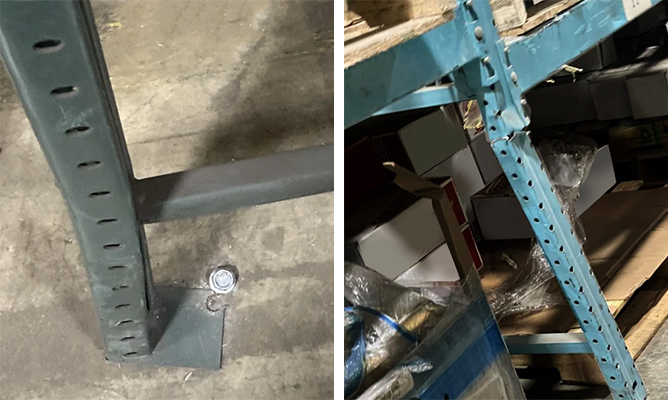
Damaged column bases, often from forklift impacts, and insecure foot plates increase the risk of collapse. Inspect bases for damage and ensure foot plates are properly bolted to the floor. Replace or repair damaged bases promptly.
Anchoring
Per ANSI requirements, pallet rack bases and anchors must be securely fastened to the building to withstand external forces. Verify the condition of bolts, nuts, and shims, ensuring proper seating and material compatibility.
Rack Beams
Inspect beams for deflection, ensuring it doesn’t exceed the maximum allowable value for the beam’s length. Calculate maximum deflection using the beam length and verify load capacity labels.
Connectors
Inspect holes and mounting points for cracks and deformation, ensuring safety pins are intact. Check for missing or damaged bolts if beams are bolted onto uprights.
Straightness and Plumbness
Confirm uprights are straight and plumb to ensure optimal load distribution. Acceptable ratios include an out-of-plumb ratio of no more than 0.5” per 10 feet and an out-of-straight ratio of no more than 0.05” per 12” of height.
FAQ’s
When should I inspect my warehouse racks?
Regular inspections are essential for ensuring warehouse rack safety. Depending on your facility’s size and usage, inspections should occur monthly or quarterly. However, it\’s crucial to conduct inspections after any modifications or damage incidents.
Who should perform rack inspections?
Inspections should be conducted by qualified personnel familiar with relevant safety regulations from organizations like the Rack Manufacturers Institute (RMI) and OSHA. In larger facilities, professional inspection services may be employed to ensure compliance.
What should I do if my racks have been recently modified?
If your storage racks have undergone recent reconfiguration, repair, replacement, or modification, it’s essential to conduct post-modification inspections. This ensures that any changes made have not compromised the racks’ safety and performance.
What are the critical areas to inspect on warehouse racks?
Several key components require inspection, including rack uprights, braces, column bases, anchoring, beams, connectors, and straightness/plumbness. Each component plays a vital role in ensuring the structural integrity and safety of the rack system.
How can I identify damage during rack inspections?
Look for signs of impacts, bends, cracks, pinches, or bulges on rack components. Measure deflection gaps and ensure they meet safety standards. Additionally, inspect for cracks, cuts, and deformation in connectors and other structural elements.
What should I do if I find damage during an inspection?
Promptly address any damage identified during inspections. Depending on the severity, repairs or replacements may be necessary to maintain the safety and integrity of the rack system. Always follow manufacturer guidelines and safety regulations when addressing damage.
Conclusion
Regular inspections of warehouse racks are crucial for safety and performance. By following recommended schedules and thoroughly evaluating critical components, managers can prevent accidents and damage. Employing qualified personnel for inspections and addressing issues promptly is essential. Post-modification inspections are also vital to ensure system integrity. By adhering to these practices, operators can maintain a safe working environment and protect inventory and equipment.